

Despite ongoing economic uncertainty, fluctuating interest rates and disciplined underwriting by buyers, one trend has remained remarkably consistent: exceptional businesses continue to command exceptional valuations. So, what separates a premium business from the rest?
The first characteristic is predictable financial performance. Buyers are willing to pay more for businesses that demonstrate consistent revenue growth, stable margins and reliable cash flow generation. This is closely tied to earnings quality, meaning the degree to which reported EBITDA reflects sustainable, recurring economics. Buyers and their advisers will normalize EBITDA to strip out anomalies, and businesses with clean, well-documented financials reduce diligence friction and preserve valuation.
Another significant differentiator is customer quality and diversification. Businesses generating revenue from a broad, loyal customer base are viewed as less risky than those dependent on one or two accounts. Recurring revenue models are especially prized because they offer visibility into future cash flows, a key input in how sophisticated buyers, particularly private equity firms, model returns.
Strong management teams also play an increasingly important role. Companies with experienced leaders overseeing sales, operations, finance and customer relationships offer smoother transitions. Businesses overly reliant on the owner face a “key person discount” reflecting execution risk after close.
Operational sophistication is another hallmark of premium businesses, including scalable systems, standardized processes, and technology such as ERP or CRM platforms that support integration and future growth. Related to this is working capital efficiency: businesses with disciplined inventory management, receivables collection and payables practices free up cash and signal operational maturity, directly affecting how a deal’s purchase price is adjusted at closing.
Market position and competitive differentiation matter, too. Companies with proprietary products, intellectual property, regulatory barriers to entry or long-term customer relationships often enjoy pricing power and margin durability. Buyers also weigh industry cyclicality and secular demand trends; businesses tied to essential, non-discretionary needs typically command steadier valuations than those exposed to discretionary spending cycles.
Growth potential remains a critical driver. While historical performance establishes credibility, buyers pay for future opportunity, whether through geographic expansion, new products, additional channels or acquisitions. Strategic buyers may also pay a premium for synergies unique to their platform, while financial buyers focus more on standalone cash flow and exit multiple assumptions.
For owners contemplating a future sale, the takeaway is clear: maximizing valuation is rarely about one strong year. It involves building consistency, scalability and sustainability well before a sale process begins, often two to three years in advance. Owners who strengthen underlying fundamentals position themselves to capture the quality premium when they enter the market.
M&A Market Activity
U.S. deal volume increased 19.1 percent for June 2026 YoY, a 2 percent increase for MoM, and a 22 percent prior YTD comparison, reflecting a surging transaction environment amid improved financing markets, record levels of uninvested capital from private equity groups, and strategic buyers returning to the market with healthy balance sheets. Additionally, many business owners postponed selling during the uncertainty of 2022 through 2024. As market conditions stabilize, those business owners are re-entering the market, increasing the number of quality businesses available for sale. M&A activity is expected to remain strong throughout the remainder of fiscal year 2026.
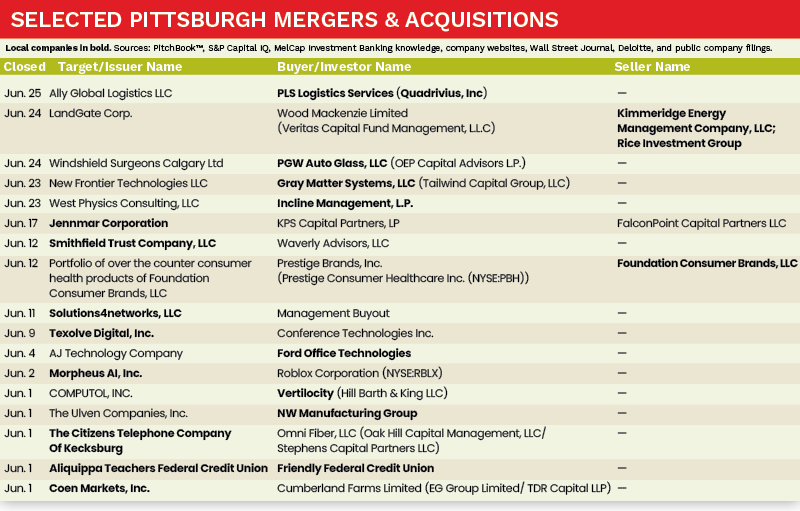
The Pittsburgh M&A market experienced a 10.5 percent increase in activity in June 2026 compared to the same period in 2025. Moreover, several noteworthy transactions completed by both strategic acquirers and private equity firms closed. PLS Logistics Services, PGW Auto Glass LLC, and Gray Matter Systems LLC all completed strategic acquisitions in June 2026.
Deal of the Month
On June 17, 2026, Pittsburgh-based Jennmar Corporation, a global manufacturer of safety-critical products and provider of specialized services, was acquired by KPS Capital Partners, LP (KPS).
Jennmar is a manufacturer of safety-critical products and engineered solutions for the mining, civil infrastructure, construction and renewable energy industries. Rather than simply supplying individual components, Jennmar acts as a single-source partner, offering integrated ground support systems, steel fabrication, engineering expertise, chemical solutions,and field services that help customers build and maintain complex infrastructure projects. The company operates approximately 80 manufacturing facilities, distribution warehouses and service centers across the U.S., Canada, Australia, Europe and Asia, serving customers worldwide.
KPS, a private equity firm focused on investing in manufacturing and industrial businesses, acquired a majority ownership stake in Jennmar, providing capital to accelerate the company’s expansion, product innovation, manufacturing capabilities and strategic acquisitions.
Sources: PitchBook™, S&P Capital IQ, MelCap Investment Banking knowledge, company websites, Wall Street Journal, Deloitte, and public company filings.
Evan J. Lyons is a Director & Principal at MelCap Partners, LLC, a middle-market investment banking advisory firm. For more information on MelCap Partners, please visit www.melcap.com or email [email protected].