
The evolving global trade environment is introducing a new layer of complexity to the mergers and acquisitions market. Tariffs, once considered a manageable external factor, have become a critical wildcard in dealmaking, forcing companies to reassess financial projections, risk exposure and long-term strategic viability. With trade barriers on the rise, dealmakers are navigating an increasingly uncertain landscape where tariff policies can directly impact valuations, deal structures and post-merger synergies. As companies attempt to mitigate these risks, many are engaging in more rigorous due diligence processes, incorporating geopolitical analysis into their assessments and rethinking their investment theses.
Since President Donald Trump first imposed tariffs on February 1, businesses across various industries face rising costs, supply chain disruptions and heightened uncertainty — factors that are restructuring the M&A landscape. Industries particularly reliant on global supply chains, such as automotive, technology and consumer goods, are experiencing increased pressure to identify alternative sourcing strategies or pass costs onto consumers.
The impact of these trade policies is already visible in market activity. According to Bloomberg data, M&A deal volume in the first two months of 2025 fell by 21 percent compared to the same period in 2024. This decline reflects not only heightened caution among investors but also a growing preference for smaller, more strategic transactions over large-scale acquisitions. For many dealmakers, the volatility surrounding trade policy has led to delayed transactions and revised valuations. Some private equity firms are debating recalibrating their investment strategies, shifting focus toward industries with more predictable regulatory environments and stable cost structures.
Despite these headwinds, the current environment also presents opportunities for nimble companies with a strategic approach to M&A that will use the shifting geopolitical landscape to their advantage by prioritizing supply chain diversification, cross-border market expansion and vertical integration. Acquiring assets in lower-tariff jurisdictions or strengthening domestic production capabilities could provide a hedge against policy uncertainty while unlocking new avenues for growth. Additionally, service-based businesses looking to be acquired would help minimize tariff exposure with little material or product sourcing, posing as a valuable asset during uncertain times. Furthermore, companies with strong balance sheets may find themselves in a favorable position to acquire distressed assets at a discount, leveraging market dislocations to drive long-term value creation.
Ultimately, while markets and businesses thrive on stability, those that can adapt to the evolving trade landscape will be best positioned to capture value. Moreover, tariffs may be implemented temporarily as a strategic negotiating tool, with the potential to be rolled back to lower levels following the resolution of international agreements. The M&A market remains a dynamic space where calculated risk-taking and strategic foresight will separate successful transactions from those that falter in the face of uncertainty. As trade policies continue to evolve, dealmakers who embrace flexibility, creativity and proactive risk management will be the best equipped to navigate the shifting terrain and emerge stronger.
M&A Market Activity
In March 2025, U.S. deal volume experienced a slight increase of 2.5 percent compared to February 2025. Spurring from the aforementioned geopolitical events, some M&A activity will likely pause. Although the tariff implementation requires additional due diligence from buyer parties, there are several practical methods to value a target company in the context of new tariffs, continuing, but potentially slowing, transaction volume.
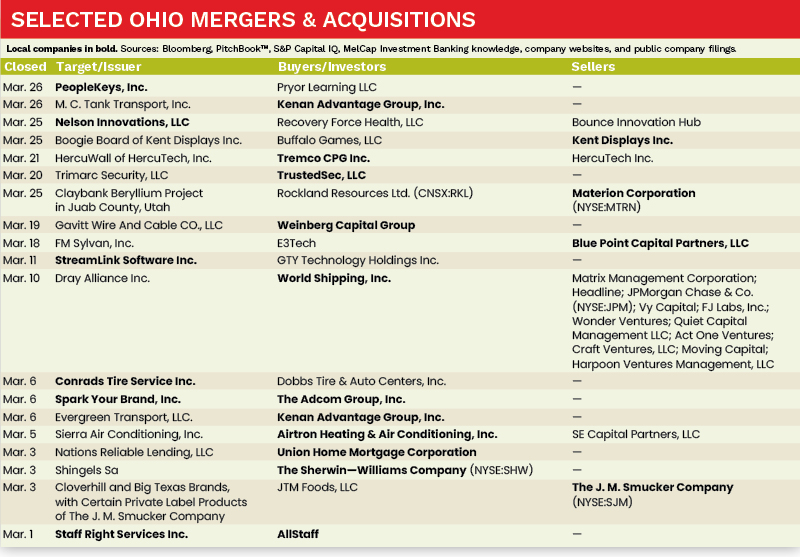
The Cleveland M&A market experienced an 18.8 percent increase in activity in March 2025 compared to the same period in 2024. Northeast Ohio-based companies Kenan Advantage Group, World Shipping, and Union Home Mortgage all completed acquisitions during the month of March.
Deal of the Month
On March 19, 2025, Cleveland-based Weinberg Capital Group announced the acquisition of Gavitt Wire & Cable. Gavitt Wire & Cable specializes in the design and manufacture of highly engineered, custom wire and cable products.
Chip Weinberg, Managing Partner at Weinberg Capital Group, said, “We are excited to partner with Ray Chesson, Tom Baker and their talented team. Gavitt has a long history of success, and we are committed to building on that legacy by investing in its continued growth while preserving the company’s strong reputation for quality, customer services and on-time delivery.” ●
Sources: Bloomberg, PitchBook™, S&P Capital IQ, MelCap Investment Banking knowledge, company websites, and public company filings.
Jake E. Peebles is a Senior Analyst at MelCap Partners LLC, a middle-market investment banking advisory firm. For more information on MelCap Partners, please visit www.melcap.com or email [email protected].