
Few issues are as consequential or as difficult to reconcile as the gap between a seller’s valuation expectations and a buyer’s willingness to pay. Most business owners have spent much of their lives building their companies, developing customer relationships, establishing their brands and creating meaningful enterprise value. When a buyer’s valuation falls short of those expectations, owners can feel disappointed and may ultimately contemplate not selling at all. To bridge this gap, M&A professionals have increasingly turned to deal structures such as earnouts, rollover equity and seller financing to allocate risk between the parties, and provide sellers with the potential for greater total consideration than an all-cash transaction may support.
Rather than allowing divergent valuation expectations to derail a transaction, thoughtful deal structures can create a framework that accommodates the perspectives of both parties. Earnouts can provide sellers with additional consideration if the business achieves agreed-upon financial or operational milestones following closing, allowing them to participate in future upside. Rollover equity allows sellers to retain an ownership interest and participate in future value creation, while also aligning their interests with the buyer following closing. Seller financing can similarly bridge a valuation gap by deferring a portion of the purchase price and reducing the buyer’s immediate funding requirement while providing the seller with additional consideration over time.
Although deal structure can support a higher valuation, excessive complexity or overly aggressive terms can ultimately become detrimental to reaching a successful transaction. Many retiring business owners prioritize liquidity and certainty of proceeds at closing, making rollover equity and earnouts less attractive. Buyers, however, view these structures as important downside protection when a portion of the seller’s valuation is dependent on future performance. The challenge is therefore not simply determining the purchase price, but establishing a structure that appropriately balances certainty, risk and future upside.
The most successful transactions are often defined not by the headline purchase price, but by the structure that enables both parties to share in the value created beyond closing. Ultimately, business sellers are seeking liquidity and a fair realization of the value they have built, while buyers are searching for strategic fit, sustainable growth prospects, and opportunities to generate returns through operational improvement or valuation arbitrage. Both objectives need to be addressed for a transaction to be deemed successful. Whether or not a transaction includes significant deal structure, the optimal outcome is one in which the economics, incentives and risk allocation are sufficiently aligned to bring buyer and seller expectations together and create a clear path to closing.
M&A Market Activity
U.S. deal volume decreased 60.2 percent for September YoY, declined 15.7 percent MoM, and increased 0.6 percent from the prior YTD period. Despite the significant decline in September YoY transaction volume, total transaction value increased 4.2 percent, highlighting a continued shift toward larger, more selective transactions as both strategic and financial buyers prioritize opportunities with clear strategic rationale, identifiable synergies and compelling valuation. Nevertheless, substantial capital remains available across both private equity and strategic buyers, providing a strong foundation for M&A activity to accelerate as market conditions and valuation expectations continue to converge.
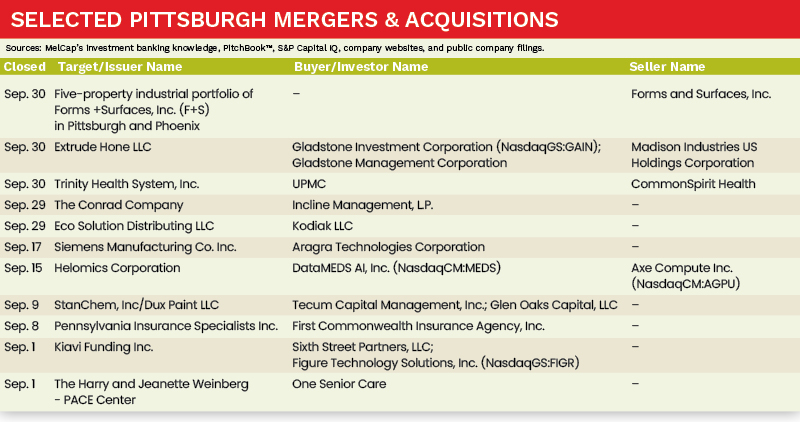
The Pittsburgh M&A market has experienced an increase in activity, with September YTD deal volume increasing 11.2 percent compared to the same period in 2025. Local private equity firms, Incline Equity Partners and Tecum Capital Management, both made acquisitions.
Deal of the Month
On September 29, 2026, Pittsburgh-based Incline Equity Partners acquired The Conrad Company, a value-added distributor and service provider of fluid power, motion control, automation and related industrial products.
Headquartered in York, PA, TCC’s pneumatic, hydraulic, automation, lubrication and compressed air offerings support a diverse customer base including manufacturing plants, food and beverage facilities and industrial customers. As a solutions provider to both OEMs and end users, the company’s comprehensive portfolio of products are supported by ongoing technical service and repair capabilities.
Michael Antonelli, Managing Director at Incline, stated, “The Conrad Company’s technical product expertise and high-quality service have supported long-term customer relationships.”
Sources: MelCap’s investment banking knowledge, PitchBook™, S&P Capital IQ, company websites, and public company filings.
Mason Bailey is an Analyst at MelCap Partners, LLC, a middle-market investment banking advisory firm. For more information on MelCap Partners, please visit www.melcap.com or email [email protected].