

For middle-market and lower-middle-market business owners, the decision to sell is the culmination of years of dedicated, direct participation to create a successful and profitable business. Owners develop a thorough understanding of day-to-day operations, with critical processes, relationships and institutional knowledge built through years of personal involvement. However, this hands-on experience can also create owner dependency, raise red flags for potential buyers, and hinder the transferability of operations. These factors are often understated when understanding the buyer’s perception of risk, which is often reflected in their view of valuation.
Owner dependency can permeate throughout the business, becoming ingrained in customer and vendor relationships, decision-making, operational knowledge and core processes. It is not simply a matter of the owner being involved in day-to-day operations; when an owner fails to establish structure and delegate responsibilities to the broader management team, operations and sustainable revenue can become dependent on the owner’s continued involvement, creating a single point of failure for the operation. Employees begin to rely on the owner for institutional knowledge and decision-making, reinforcing dependency and limiting the businesses’ ability to operate independently. Buyers can identify these risks during diligence and negatively impact their confidence in the next-generation management’s ability to continue operations and generate revenue without interruption, particularly involving a complete or majority exit by the owner.
Reducing owner dependency should begin well before the decision is made to sell. Sellers can begin to assess the associated risks by identifying and documenting processes that are required to flow through the owner on a daily, weekly and monthly basis. By establishing clear and defined roles across the organization and delegating critical responsibilities and relationships to capable next-generation management members, the owner is able to reduce reliance on any single team member and develop standard operations at all levels of the business. These efforts to identify and remediate key-man risks ease the burden on the owner, improve operational efficiency, and demonstrate to buyers the ability for operational continuity of the business post-close. The earlier the risks are identified, remediated and documented, the greater the runway for management to track and demonstrate operational independence from the owner.
Ultimately, reducing or eliminating owner dependency can create value without increasing EBITDA simply by reducing the risk. A professionalization premium is reflected in businesses that are supported by proven management teams and reinforced by documented processes, which provide the buyers with greater confidence in the ability of the business to continue operations and revenue generation uninterrupted. By reducing owner dependency, the company can be separated from the owner and reduce key risks and red flags that buyers may use to negotiate a lower value.
M&A Market Activity
U.S. deal volume decreased 23 percent for August 2026 YoY, a 19.5 percent decrease for MoM, and a 2.5 percent Prior YTD decrease, highlighting a transition towards higher selectivity with both strategic and financial buyers prioritizing transactions with clear strategic rationale, obtainable synergies, or attractive valuation. Additionally, while financing conditions have improved, interest rates remain relatively elevated, creating difficulties in underwriting justification. Despite the monthly decrease, we expect significant dry powder on hand for private equity and strategic buyers to help the M&A market to remain strong through the remainder of fiscal year 2026.
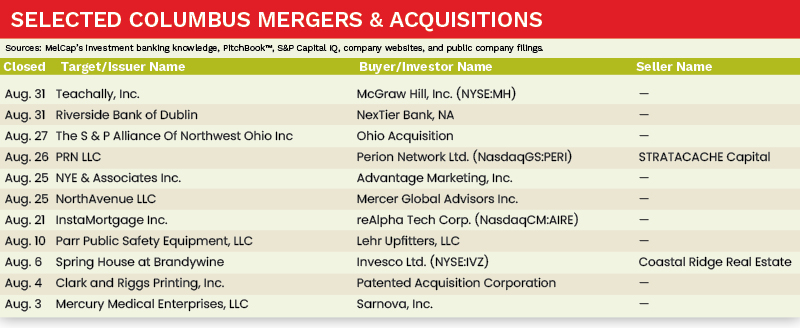
In August 2026, the Columbus M&A market saw a significant decrease in M&A activity, with month-over-month deal volume retreating by 50 percent. Local companies including McGraw Hill Inc., Advantage Marketing Inc., and reAlpha Tech Corp., all completed strategic acquisitions.
Deal of the Month
On August 26, 2026, Dayton, Ohio-based PRN LLC, an Ohio-based in-store retail media company with partnerships across several North America’s largest retailers, completed its sale to Perion, an advanced technology leader solving for the complexities of digital advertising through AI-native execution infrastructure. Perion anticipates the combination of its digital advertising scale with PRN’s retail presence will attract a larger percentage of advertiser budgets and accelerate growth across Retail Media and Digital Out-of-Home (DOOH) channels.
“This expands our TAM across the retail media market and opens budgets that have not historically been programmatically addressable,” said Tal Jacobson, CEO of Perion.
Sources: MelCap’s investment banking knowledge, PitchBook™, S&P Capital IQ, company websites, and public company filings.
Jacob Voight is an Analyst at MelCap Partners, LLC, a middle-market investment banking advisory firm. For more information on MelCap Partners, please visit www.melcap.com or email [email protected].