

The Federal Reserve continues to play a central role in shaping the U.S. M&A market. With the federal funds target range currently at 3.50–3.75 percent, financing conditions have improved from the peak of the recent tightening, but capital remains expensive and selective relative to the historically low-rate environment experienced during the COVID-19 pandemic.
For the world of M&A, the impact of rates is straightforward: higher rates make debt more expensive, reduces leverage, increases required equity and places downward pressure on valuations. Lower rates tend to have the opposite effect. The end result is transaction volume and deal quality becoming increasingly tied to the ability of buyers to finance acquisitions at attractive terms.
Interest rates have their most immediate effect on M&A through the lending market. Many acquisitions, particularly private equity transactions, rely on leveraged loans or private credit. These financing structures are often tied to floating interest rates, meaning that changes in benchmark rates can quickly affect a buyer’s interest expense.
The Federal Reserve’s July 2026 Senior Loan Officer Opinion Survey shows that banks continue to report tighter lending standards for commercial and industrial loans, as well as loans involving private equity funds and other nonbank financial institutions.
While deal financing is still a viable option, the terms are becoming more heavily scrutinized. Buyers are increasingly focused on interest rates, leverage multiples, covenants and debt-service coverage — not simply whether a lender will provide financing.
One of the most important effects of higher rates is the shift in the types of businesses buyers are willing to pursue and the valuations they are willing to pay. In a low-rate environment, inexpensive debt can make it easier to justify paying premium valuations for companies with strong growth expectations. When financing costs rise, buyers become much more focused on current cash flow and the certainty of future earnings. Today’s most attractive M&A targets tend to have predictable revenue, which provides greater confidence in future cash flow. Higher margins provide greater flexibility to absorb higher interest expense. Businesses that generate substantial free cash flow without significant ongoing capital expenditures are particularly attractive to leveraged buyers. A shared thought amongst buyers is companies with strong competitive advantages are better positioned to withstand economic uncertainty. Strategic buyers can justify premium valuations when an acquisition creates identifiable cost savings or revenue opportunities.
Besides influencing the cost of debt, the Federal Reserve helps determine size, structure, valuation and quality of the overall M&A market. If rates continue to decline while credit markets remain stable, M&A activity could broaden significantly. If rates remain elevated, dealmaking is likely to remain concentrated among well-capitalized buyers pursuing high-quality assets with solid justification.
M&A Market Activity
U.S. deal volume increased 6.4 percent for July 2026 YoY, a 1.2 percent increase for MoM, and a 21.2 percent Prior YTD comparison, showcasing a transaction environment with an increased focus on high-quality assets. With record levels of dry powder for private equity, and strategic buyers hungry to add defensive cashflow to their books, a greater focus on healthy business is driving deals in most segments of the M&A markets. Furthermore, with continuation funds increasing due to slower exits, many buyers are shifting their focus on larger deals. M&A activity is expected to remain strong throughout the remainder of fiscal year 2026.
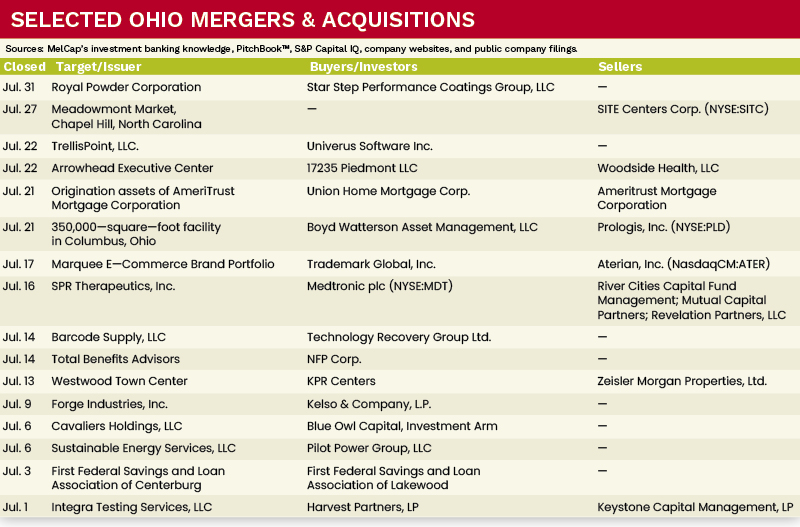
In July 2026, the Cleveland M&A market saw decreased expansion, with month-over-month deal volume decreasing by 20 percent. Local companies Royal Powder Corporation, Forge Industries Inc., and Cavaliers Holdings LLC were all acquired by out-of-state entities.
Deal of the Month
On July 16, 2026, Cleveland, Ohio-based SPR Therapeutics, Inc., was acquired by Medtronic plc (NYSE: MDT), a global leader in health care technology. SPR’s SPRINT PNS System (which is FDA-cleared) is a short-term therapy designed to provide pain relief using a 60-day, minimally invasive treatment approach that does not require permanent implants.
“The addition of SPRINT extends our ability to serve patients across the continuum of pain care and broadens patient access to a minimally invasive treatment option to address both chronic and acute pain,” said Domenico De Paolis, Interim President of the Neuromodulation Operating Unit, part of the Medtronic Neuroscience Portfolio. ●
Sources: MelCap’s investment banking knowledge, PitchBook™, S&P Capital IQ, company websites, and public company filings.
Austin Irussi is an Analyst at MelCap Partners, LLC, a middle-market investment banking advisory firm.
For more information on MelCap Partners, please visit www.melcap.com or email [email protected].