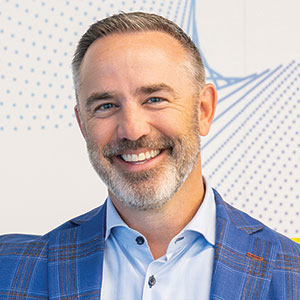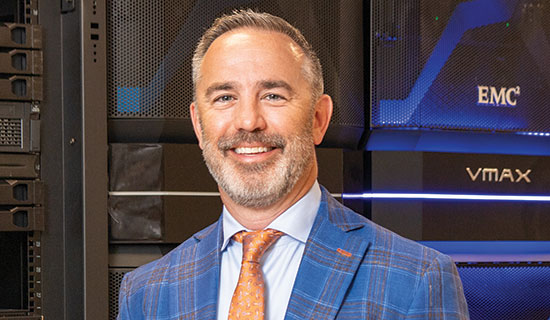
When Chris Adams first joined Park Place Technologies 20 years ago as chief financial officer, the company had about 100 employees and $10 million in revenue. Looking back, he says there’s really no comparing that small company to the global IT services firm it has become — today it has $1.2 billion in revenue and more than 3,000 employees serving customers in 180 countries.
Through a combination of calculated organic growth and strategic M&A, Park Place Technologies has steadily scaled its tech empire to build the world’s largest on-the-ground engineering team, working 24/7/365 to support tens of thousands of organizations globally. In fact, half of the Fortune 500 depends on Park Place Technologies for IT infrastructure management.
Orchestrating international growth at this scale isn’t just about expanding services, gaining market share or multiplying the workforce. Through it all, Adams and his team have worked hard to maintain the foundational people-first culture that drives performance at Park Place.
“In that regard, we’re fairly similar to what we were 20 years ago,” says Adams, president and CEO since 2019.
Here’s how Park Place preserves its “work hard, play hard” culture while scaling into a billion-dollar global leader.
Building a sales engine
The first phase of Park Place’s monumental expansion was designing an effective organic growth model, built on recruiting and training salespeople instead of trying to hire experienced talent.
Initially, new sales hires would shadow a more experienced employee to learn the ropes. Then, around 2008, Park Place started to create recruitment profiles based on the traits that typically defined success.
For example, they realized that Division III college athletes tended to outperform other hires significantly, perhaps due to the “grit, perseverance and determination” these star players brought to the team.
“In sales, our win rate any given month is about 22 percent,” Adams explains. “Imagine getting knocked down three out of every four times you try. These [former athletes] are committed, driven people who just keep getting back up.”
This discovery happened about 16 years ago when a Baldwin Wallace football player joined Park Place as an accounting intern and started telling the rest of his team about the company. As more former athletes came onboard, the profile began to crystallize into a defining characteristic. Now, Adams says, “These kids we hired 16 years ago are now running everything and doing an amazing job.”
These recruiting profiles have naturally evolved over time as the company gathered more data about employee performance, while also crafting an onboarding program to develop new talent. Sales recruits spend about six months in training, half of which is dedicated to business development in their territory. In addition to sales leaders who manage each territory, Park Place appointed “residency managers” who oversee early-stage sales reps by monitoring their calls and honing their skills.
“Now it’s a machine, because they all do it the same way,” Adams says. “It’s consistent because of how we’ve recruited, hired, trained, developed and managed people for nearly 20 years.”
Thanks to this standardized approach, Park Place peaked at nearly 50 percent organic annual growth. But Adams knew this sales model wouldn’t last forever.
Acquiring new avenues of growth
Part of Park Place’s success was simply due to having “the right formula at the right time in the right industry,” Adams says. Essentially, the company sells annual maintenance contracts for IT assets after the initial three-year warranty from the OEM expires, offering a savings of up to 40 percent compared to OEM pricing.
Although OEMs practically owned the market when Park Place Technologies launched in 1991, a slew of similar third-party maintenance providers have sprung up since then.
“We were a very fragmented industry with a lot of $10-, 20-, 30-million businesses that all did the same thing,” Adams says. “So, I put together a plan to buy companies and roll their contracts and their people into our platform. Had we not done that, then someone else would’ve rolled us up like we rolled them up. We were well ahead of everybody in our space with our M&A strategy.”
Around 2016, Park Place Technologies began making strategic acquisitions by absorbing other companies that offered similar third-party maintenance services.
“Historically, our M&A strategy was buying companies just like us,” Adams says. “We plugged them into our model, creating a ton of synergies and a ton of value.”
But Adams realized that single-product approach wouldn’t provide sustainable long-term growth.
“We had a great sales model and we were rolling up the industry, but we were just one product,” he says. “You do all this work to get a customer on the phone, but if they didn’t want your one product, you just hung up. That seemed silly to me, so we started adding adjacent services and then adding adjacencies at scale through acquisition.”
In 2019, Park Place Technologies made its first acquisition outside of the third-party maintenance category with a network performance monitoring software provider that significantly enhanced its managed service business.
“There are a lot of managed service providers, but they’re all dependent on third-party software. They don’t have their own technology,” Adams explains. “This acquisition gave us a competitive advantage by giving us our own technology we could plug into our go-to-market solutions for our customers.”
Integrating business acquisitions
Integrating companies with adjacent products proved much more complicated than just rolling up similar companies with identical service offerings. It required more meticulous due diligence, more rigorous tire kicking and more sophisticated integration plans.
“People think it’s cool or sexy to buy companies, and I guess it’s great conversation for dinner parties, but M&A isn’t about what you buy; it’s about how you integrate it,” Adams says. “You can find poor-performing businesses and plug them in well and turn them into successes. And you could buy a really good company and screw it up because you don’t know how to do integration.”
Before closing an acquisition, Adams tries to “get as intimate as possible with the business” by dissecting every process and drilling the leaders with questions about everything from products and services, customer and talent acquisition to the cultural values underneath it all.
“The product fit has to make sense, but if we don’t think it’s a cultural fit, we won’t do it,” he says.
As critical as that upfront investigation is, the heaviest lift happens after a deal closes.
“It’s all about having a good integration plan and a good team that can execute that integration,” Adams says. “It’s a full-time job, so if you dump it on your employees, you’re going to struggle to be successful.”
To that end, the integration team at Park Place consists of three full-time staff supported by “an army of project-based employees,” many of whom are retired or former employees who contribute valuable skillsets to each integration.
Although the service offerings, technology platforms and operational workflows may differ across each acquisition, the key tenets of Park Place’s people-focused culture provide a common denominator for smooth integrations.
“If your culture is to take care of employees and treat people well, that’s a universal language that will get you through any M&A,” Adams says. “People come in with different practices, but if you give them a sense of belonging, engagement in the process and some ownership in the outcome, they generally respond well.”
Maintaining a people-focused culture
Whereas 10 years ago, Park Place peaked at nearly 50 percent organic growth, Adams estimates that more than 50 percent of the company’s current market cap is the result of acquisition. This growth streak includes the most recent merger that closed in January 2026, on the heels of the May 2025 acquisition of a UK-based managed service provider, which marked one of the largest deals in the company’s history.
“When you add big chunks of growth with new cultures and new people, maintaining your culture can be difficult,” Adams says. “You have to make sure you’ve got all the right people around you that have similar values, because people are going to look to whoever is ahead of them for direction on how they should conduct themselves.”
Adams describes the culture at Park Place as a balance of “work hard, play hard.”
“People are heads-down, driven and committed, because ultimately, we have to perform for the company to be successful,” he says. “But to that, you can’t have them grinding at their desk all day.”
He believes that his employees’ hard work deserves a reward, in the form of fun amenities that range from basketball courts to foosball tables and putting holes. If Adams visits the company’s fitness center around 3 o’clock in the afternoon, he’ll find the payables team from the accounting department walking on treadmills together. During lunch, he’ll see several employees engaged in a pickleball game, and later in the afternoon, a couple of sales reps might be playing ping-pong.
This amenity-rich culture was inspired by one of Adams’ first jobs working at a country club.
“I remember thinking, someday I’d like to be on the other side of this,” he says. “You’ve got to earn your way into a country club, and I wanted to create an environment at Park Place where people want to get in. I wanted it to be a challenge, but a reward, so people would say, ‘I got into a company where I have to work hard, but there are a lot of benefits to it.’”
These amenities were a key focus when Park Place moved into its new global headquarters in Cleveland’s Highland Heights neighborhood last year. The campus features outdoor basketball and pickleball courts, a commercial-sized fitness center, a full-service industrial kitchen, health clinics, dental services, a hair salon, and a licensed daycare facility.
Although Park Place can’t provide the same level of amenities at every location around the globe, the company does offer reimbursements for health clubs and is currently negotiating discounted rates with national childcare providers.
After all, Adams says, the reason why employees work so hard is so they can take care of themselves and their families — and that is the ultimate goal behind Park Place’s growth.
“You can be as nice as you want, but if they can’t take care of their family, they’re going to leave,” Adams says. “As CEO, I’ve got to make sure we grow so that every year we can pay increases, create jobs and offer promotions. You’ve got to grow your business to take care of the people. That’s why we have the ‘work hard, play hard’ culture. Being a people company, you’ve got to invest in them, or you’ll lose them.”
Setting a vision for the future
At a recent meeting kicking off the integration process for Park Place’s latest acquisition, someone asked Adams to describe his BHAG (big, hairy, audacious goal) for the company. His answer was not a huge annual growth rate of 20 percent, but steady upper single-digit growth for the next 20 years.
“If we do that, we can take care of our people consistently,” he says.
Maintaining this manageable pace of growth requires strategic prioritization. Instead of layering too many goals on his team at once, Adams plans to focus on this integration throughout the year before moving to the next target.
“Would I like our data center liquid cooling business to be farther along? Yeah. But I’m not going to push that this year because I’d like to have some cookies in the jar for next year,” he says. “You have to have the right balance between pushing hard, but not too hard.”
Looking ahead, the new headquarters will provide ample room for growth as Park Place continues to expand. The company had completely outgrown the facility it was previously renting, necessitating a move to the 330,000-square-foot tech campus in Highland Heights. With another unoccupied building and additional space to build another facility on-site, Adams says the campus can fit three to four times more people than the 500 or so employees currently stationed at the corporate headquarters.
“I want to create an environment where people can thrive,” Adams says. “There’s always more you could add, but we’re getting closer and closer every year.” ●