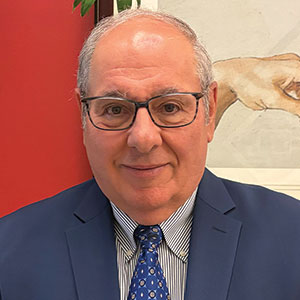
One Saturday in 1984, Dr. Rustom Khouri drove past a small commercial building that he and his wife, Mary, had just purchased that week. The building was supposed to be fully leased, but he found it empty, abandoned overnight by its sole tenant.
“We were panic-stricken. Where were we going to get the money to pay the mortgage?” says Khouri, who was still practicing medicine when his wife — a chemist from a family of prominent real estate investors in Australia — had the idea to start buying investment properties in the mid-80s.
Some investors may have seen the empty building as an early warning sign, but for Khouri and his wife, it marked the unlikely launch of Carnegie Management and Development Corp. Rather than exiting the business, they dedicated themselves to learning the intricacies of the industry.
Over the next four decades, Carnegie evolved from a modest investment venture into a nationally recognized real estate development and management company, which has since developed 10 million square feet of real estate across 19 states.
“Our success was born out of failure,” says Khouri, who serves as CEO while his wife fills the role of chief administrative officer.
Carnegie’s steady growth is the result of prioritizing pre-leased properties instead of speculative development, with an eye toward long-term asset security and low-risk thresholds rather than short-term profits. Standardized processes and layers of internal oversight have allowed Carnegie to gradually scale without sacrificing quality — proving that the strongest companies are not built fast, but built to last.
Developing a blueprint
In the mid-1980s, when many developers were struggling to finance projects, Khouri and his wife saw an opportunity to invest as others scaled back. They made a deal with a local broker to buy his site, his building plans and his lease with Sears Hardware. With financing from a few investors, they took over his project to build Centerpointe Plaza in Medina, anchored by Sears.
“We did such a nice job that Sears showed up at our office a few months later and said, ‘How would you like to build 20 shopping centers anchored by Sears?’” Khouri recalls. “I didn’t have a clue what I was doing, but I said, ‘Sure.’ That’s how our company really started.”
Over the next five years, Carnegie grew by finding sites to meet Sears’ specs, then building stores to suit and leasing them back to the hardware retailer. Next, the company built another 20 shopping centers anchored by Office Max, gaining the attention of other national retail chains. Khouri eventually left his medical practice to join the company full time. As the pace of projects increased, he and his wife began assembling a team and building a more robust process.
“As you grow, you need more people and you need to have a standardized structure in place that they can follow, because you can’t monitor every detail on every project, but you have staff that can,” Khouri says. “As long as they have a blueprint to follow, they can avoid hardships on projects.”
To develop those “blueprints,” Khouri pored over the bank’s property appraisals to understand which details mattered most.
“Those reports told you everything you need to know about real estate,” he says, such as the utility costs per-square-foot, estimated taxes and market rates for rentals by tenant type and usage. Then, he incorporated the site selection requirements from Sears and Office Max to create his own standardized forms and checklists.
“We have forms for everything,” he says. “We have a 10-page process development form that covers everything from site selection and acquisition to feasibility. We have site forms we give to brokers that tell you every vital detail about a site — zoning, topography, soil, utilities, all those things — which helps you avoid problems down the road.”
Meanwhile, Carnegie continued hiring experts with the knowledge to refine these forms and processes even further. After every item is crossed off the checklist, an internal inspection team reassesses all of the criteria to verify that no detail is overlooked.
“We learned that performance success is the result of having a good strategy and good people who can execute on that strategy to create a quality product that tenants and clients are happy with,” Khouri says. “You do that by having an organized structure in place that people can follow.”
Shifting focus
As Carnegie’s process matured, its portfolio of properties also evolved.
“Originally, the perfect fit for Carnegie was the opportunity in front of us,” Khouri says.
Early on, the company focused on national retail anchors such as Sears, Office Max, Walmart, Target, Blockbuster Video, and other video stores and cell phone chains that don’t even exist anymore.
“In the late 90s, we started to see a shift in the retail market,” Khouri says. “The market was being overbuilt, tenants and technologies were changing, and we had a sense that the companies you thought were rock solid, like the Blockbusters of the world, might not be around in five or 10 years, and that panned out to be true.”
Fortuitously, in the late 1990s, Carnegie had the opportunity to bid on a government project for the FBI in Cleveland.
“While we didn’t win the job, the government liked our proposal and encouraged us to bid more projects,” Khouri says. “We learned what our mistakes were and corrected those mistakes, and we won the next five bids we did for the federal government.”
While some retail-focused real estate development companies went under as the market shifted, Carnegie pivoted toward government projects — a complex and demanding niche that makes up the majority of its portfolio today. While the barriers to entry in this market keep many developers at bay, the strict standards and exhaustive documentation requirements became a competitive advantage for Carnegie’s keen attention to detail.
“Your average proposal on a federal government lease is somewhere in the neighborhood of 1,500 pages,” Khouri says. “It’s so much more intense. It’s not like building a Sears or a Walmart, so you have to be extremely detailed, and you need to hire a much larger team of architects, contractors and civil engineers that are local to the market you’re bidding in.”
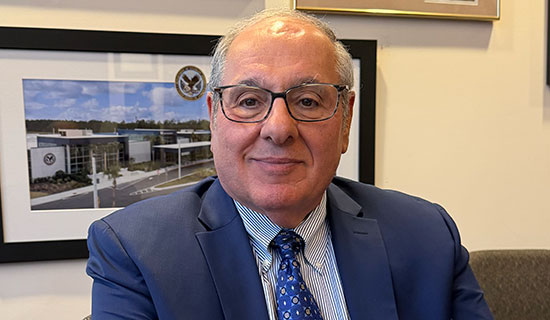
Today, Carnegie acts as a landlord for a number of “mission critical” government buildings across the country that are leased by the FBI, the IRS, federal court systems and, primarily, the Department of Veterans Affairs (VA). Khouri’s medical background has been instrumental in bidding and building outpatient clinics and medical centers for the VA.
“As a physician, you understand the details that are important to successful operations in a medical facility,” he says. “Our proposals address specifics in a level of detail that I’m not even sure the government expected. A lot of times, we’re educating them about things they need to know to improve their facility, and that’s why we’ve risen to be one of their best development companies nationally.”
In late January 2026, the VA awarded Carnegie two 20-year contracts to develop and manage new outpatient clinics in Baton Rouge, LA, and Clarksville, TN, valued at more than $537.5 million. As intensive as the development process is, Khouri says, the management commitment is just as demanding, requiring a robust team of skilled management staff dedicated to long-term client satisfaction.
Planning for the future
Although Carnegie’s headquarters in Westlake, Ohio, only houses about 36 employees, the company employs about 1,500 people across the country, including national architects and contractors, local civil engineers, on-site management staff, and landscapers, cleaning crews and other teams that service each property.
“Our company today is built for growth and built for the future,” Khouri says. “Being in business for 42 years, a lot of our senior managers are getting old, so over the last 10 to 12 years, we’ve hired good middle managers that have been learning under successful senior managers, so when they retire, we can promote from within. It eases the burden of growth, which allows us to expand.”
Khouri’s succession plan includes his sons — Jonathan, a former assistant attorney general who serves as Carnegie’s general counsel and chief operating officer, and Rustom Khouri III, who became president of the company in April 2024 and spearheads the federal contracting business.
“Between him and Jonathan and the internal management team that we’ve promoted, I think we’re in pretty good shape,” Khouri says. “Without a good team, you will not succeed in this business.”
While the technical aspects of real estate development and management are taught by shadowing and “troubleshooting together,” Khouri says the company’s ultimate legacy relates to its tenets of trust and integrity.
“We’re firm believers in the power of relationships, and we want the next generation to continue valuing relationships because mutual trust and respect [are the keys] to resolution. Our focus on honesty and truth is really what has built the company to the level it’s at now. Clients need to know that they can trust you, and that triggers future business for our company.” ●
Building community
In addition to their professional roles in real estate development, Dr. Rustom and Mary Khouri are also active in civic and community organizations that support children’s welfare, education, health care, law enforcement and religion.
“We’ve been very involved with organizations that support children — children’s health and education,” Khouri says. “It shouldn’t matter what zip code you live in; children should always be given the opportunity to succeed and realize the American dream.”
About 25 years ago, the couple formed an eponymous, nonprofit family foundation to coordinate their philanthropic efforts. Since then, Khouri estimates that they’ve supported 350 charitable organizations with millions of dollars in donations — including $8.5 million raised for the St. Jude Dream Home Giveaway benefiting St. Jude Children’s Research Hospital, for which they donated property on the Red Tail Golf Club in Avon, which the family also owns.
In 2018, the couple committed $3 million to support renovations at University Hospitals St. John Medical Center for the emergency department, which was renamed the Khouri Center for Emergency Medicine in recognition of their gift — the largest gift to the hospital at the time.
The Khouri family’s philanthropy extends throughout Carnegie Management and Development Corp. through annual company-wide service days devoted to supporting local organizations like the Cleveland Food Bank and MedWish Medworks.
Additionally, the couple has served on numerous boards, with Mary donating time to organizations like Habitat for Humanity’s Partners Council; Ursuline College Board of Trustees, where she chairs the development committee; and Rainbow Babies & Children’s Hospital Foundation, where she serves as a trustee. Dr. Khouri, meanwhile, has served as a board member for Saint Ignatius High School, Lorain County Community College Foundation and Cuyahoga County Crime Stoppers, from which he recently stepped down as chairman.
Khouri’s giving spirit even extends beyond Northeast Ohio. Pope Francis appointed him to the board of Caritas for Children, a Catholic service organization focused on providing education and basic needs to children around the world.
“We’ve raised about $50 million to support international children’s relief,” Khouri says.
Khouri got to visit Rome and hold an audience with the Pope, and even had the honor of being knighted by him.
“It was a highlight of my life,” he says. “I still get goosebumps when I think about it.”
TAKEAWAYS
- Develop repeatable processes for producing consistent quality work.
- Anticipate market shifts, and be flexible enough to pivot.
- Plan for the future by grooming the next generation of leaders.