
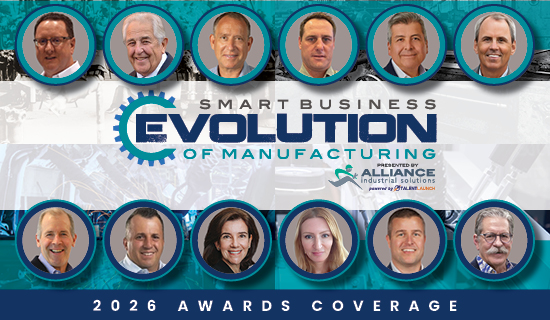
Manufacturing With Intention
Why the most resilient manufacturers in 2026 are leading with purpose, not pace.
Alliance Industrial Solutions is proud to once again serve as the presenting sponsor of the Evolution of Manufacturing Awards, honoring the innovators, builders and leaders shaping the future of Northeast Ohio’s manufacturing community.

Chief Operating Officer,
Alliance Industrial Solutions
This year, the spotlight isn’t just on what’s being made, but how. In an industry built on precision and output, the manufacturers thriving in 2026 are showing that being intentional with how they lead is just as critical as how they operate.

Baer,
Chief Growth Officer,
TalentLaunch
They’re slowing down — not production, but the decision-making that affects people. They’re rethinking communication, mentorship, onboarding and culture. They’re choosing to lead with clarity instead of reacting in chaos.
Because in a year where hiring has cooled and margins are tight, purposeful leadership isn’t a luxury. It’s a competitive edge.
The best manufacturers aren’t just chasing efficiency; they’re building environments where people stay, grow and care. They’re not just making parts; they’re making progress, on purpose.
This year’s honorees are proof of that mindset in action. By leading with intention and investing in their people, they’re adapting to change while defining what success looks like for the region.
Congratulations to the 2026 Evolution of Manufacturing honorees. Your thoughtful leadership and steady vision continue to set the pace for what’s next. ●
2026 Evolution Honorees
 AKS Cutting Systems has been designing and manufacturing Made-in-the-USA equipment for over 100 years. To stay competitive, the company has heavily evolved its manufacturing practices, moving from contract manufacturing to creating a full line of plasma and waterjet cutting systems.
Led by President Greg Phillip, AKS prides itself on offering fully integrated CNC machinery that is easy to use and completely customizable. Customers rely on the company for equipment that streamlines production and reduces costs. Through innovative products, AKS has helped customers around the world.

Greg Phillip,
President
Robo-kut Technology is AKS’s first-of-its-kind five-axis beveling system. Developed in 2012, this system still leads the industry, offering unparalleled accuracy and allowing precise cuts at multiple angles. Unlike competitors, Robo-kut can effortlessly produce half-inch bolt-ready holes in one-inch plates. These capabilities exceed traditional 1:1 ratios, making the tool the most powerful five-axis plasma cutting bevel head on the market.
Combined with the Hypertherm XPR plasma power supply, AKS machinery can be used to process steel plates and tubing, complete weld prep, drill holes and carry out geometry marking via a single system. This technology enables customers to reduce downtime and increase throughput.
AKS partners with Hypertherm to deliver the best upgrades to its clients. In 2025, AKS customers gained access to Hypertherm’s HySpeed technology, allowing for cutting thin-gauge materials at more than double the speed of standard plasma cutting. This is increasingly important as businesses look to increase throughput and profits amid a changing economy. ●
 Founded in 1878, APV Engineered Coatings manufactures and customizes industrial coatings and advanced chemical products at its state-of-the-art facility in Akron. The company has expertise in the research, development and commercialization of high-performance products. APV partners with some of the world’s top manufacturers, and its innovative solutions have been integrated into multiple industries for niche applications. At APV, clients work with knowledgeable, personable staff focused on delivering optimal solutions in an unprecedented timeframe.

David Venarge,
Chairman
Throughout its 145-year history, APV has continuously evolved, adapting and overcoming challenges to achieve success in the coatings industry. The company continues to focus on being a top-tier workplace where employees collaborate to expand into additional coating-related markets while consistently providing solutions to clients’ coating-related problems. APV guarantees the quality and delivery of its products while investing in R&D to solve new and different problems that clients may bring to the company.
By developing its team and focusing on quality, APV has become one of the largest names in the coating industry. The company has expanded to support industries, including aerospace and construction, and produces materials such as films, fabrics, rubbers and plastics. According to PCI Magazine, APV Engineered Coatings is ranked among the top 25 North American paint and coatings manufacturers.
Led by Chairman David Venarge, APV cares about its employees and puts them first every day. From new hires to team members with years of experience, the company treats everyone with respect, enabling employees to grow and thrive. ●
 Combi Packaging Systems built its reputation on innovation, adaptability and customer-centric engineering. Founded in 1979 and headquartered in North Canton, the company has continually evolved to meet the demands of a global economy where efficiency, sustainability and customization are paramount.

Brian Vincent,
President and CEO
In recent years, Combi has invested strategically in automation and robotics, developing advanced case erectors, tray formers, case sealers, robotic case packers and palletizing solutions. These systems are designed not only to increase throughput but also to integrate seamlessly into worldwide manufacturing environments. By offering modular and customizable solutions, Combi empowers manufacturers across industries, from food and beverage to automotive and pharmaceuticals, to remain competitive in international markets.
Equally important, Combi has embraced sustainability and lean manufacturing principles. Its packaging systems are engineered to reduce material waste, optimize energy use and support ergonomic workstations that improve employee safety and productivity. This proactive approach enables Combi’s clients to meet evolving regulatory standards and consumer expectations for environmentally responsible practices. Through these initiatives, Combi has demonstrated a clear ability to anticipate global trends and adapt its manufacturing operations to serve a dynamic, interconnected economy.
Led by President and CEO Brian Vincent, Combi’s manufacturing operations have yielded measurable impacts across the organization. Automation and modular design have streamlined production, reduced downtime and enhanced scalability. The company’s systems now deliver higher reliability and flexibility, enabling customers to respond quickly to market shifts. While automation has reduced repetitive tasks, Combi has expanded opportunities for highly skilled engineers, technicians and customer support professionals. ●
 DEM Manufacturing has built a name as one of Northern Ohio’s most agile and technically advanced OEM partners. With a vertically integrated process and a U.S.-based team of engineers, technicians and manufacturing experts, DEM helps companies bring complex electronic products to market in as little as 10 weeks.

Craig Padula,
President
Under the leadership of President Craig Padula, the company’s precision-focused, end-to-end model continues to evolve to meet the demands of modern product development across medical, military, defense and industrial sectors. Founded in 1993, DEM has grown from a small custom molding shop into a full-service product development partner.
Today, everything from electrical engineering and circuit design to rapid prototyping and final assembly happens under one roof. To meet the demands of a changing market over the past decade, DEM has taken strategic steps to address supply chain delays, fragmented outsourcing and rigid manufacturing models. The company has built an agile process that eliminates common handoff issues between design and production. Projects start with mechanical and electrical engineering, move through internal validation and rapid iteration, and transition directly into tooling, assembly and test — without ever leaving the facility.
DEM’s technical strength stems directly from its people. Cross-functional teams include electrical and mechanical engineers, tooling specialists, PCB layout experts and quality managers who are deeply involved in every project. From early-stage requirements definition through validation testing, DEM’s team works side-by-side with customers’ engineering and procurement teams. This collaborative model helps uncover design risks early, optimize for manufacturability and reduce the need for costly revisions. ●
 Diebold Nixdorf is a multinational financial and retail technology company based in North Canton. Security is embedded in the company’s DNA, dating back to its early days as a safe manufacturer more than 160 years ago. Diebold Nixdorf’s history of innovation includes introducing the circular vault door, drive-up banking and the first voice- and iris-recognition ATMs.

Octavio Marquez,
CEO
Led by CEO Octavio Marquez, Diebold Nixdorf is today a strategic, collaborative, end-to-end provider of services, software, hardware and security. With clients around the world, the company is driving the future of self-service for bankers and retailers.
To stay ahead of unpredictable supply chains and a rapidly evolving global economy, Diebold Nixdorf remains proactive, strategic and adaptable. By embracing lean methodologies, tools and principles across all areas of the business, the company has cultivated a culture of continuous improvement. This transformation drives cross-functional collaboration, sparks new ideas, encourages learning through hands-on experience, and rejects the notion of “good enough.”
Front-line employees have a voice and play an active role in shaping change. Leaders at every level engage with Gemba, “where value is created,” and Kaizen workshops have become a regular part of their practice. As a result, operations have achieved significant reductions in process lead time, manufacturing cycle time, inventory and assembly footprint.
Complementing this lean approach, the North Canton location has implemented a local-for-local strategy, manufacturing in the markets where products are sold. This shift reduces reliance on overseas production, simplifies logistics, shortens supply chains, improves quality and lowers lead times and costs. ●
 Helix Linear Technologies, headquartered in Beachwood, is recognized as an advanced manufacturer of precision ball screws, lead screws and linear actuators. To serve new and growing markets, including aerospace, the Department of War, and advanced manufacturing, Helix has implemented cutting-edge technologies to fabricate, assemble and test products that meet stringent performance requirements.

Christopher Nook,
CEO
Led by CEO Christopher Nook, Helix has embraced smart manufacturing methods, integrating data systems, collaborative robots (cobots) and custom automated production machines to streamline operations and improve efficiency. The company has also invested in advanced inspection equipment, including ball screw efficiency test stands and ID ball nut grinding systems, ensuring the highest levels of precision and reliability. These initiatives reflect Helix’s commitment to leveraging automation and engineering expertise to deliver custom solutions for demanding applications.
Helix’s investments in automation and advanced manufacturing have transformed operations and fueled growth. The company has launched a product line to meet advanced actuator requirements, broadening its market offering and increasing sales and jobs. Significant investments in automated systems and cobots have reduced cycle times, improved precision and enhanced quality control, enabling the company to meet the rigorous standards of the aerospace and defense markets. These upgrades have supported expansion in both workforce and capabilities, creating opportunities for employees to work with advanced robotics and smart systems. The product mix has evolved to include a broader range of ball screws, lead screws and actuators, as well as custom-engineered solutions for high-performance applications. This diversification has strengthened Helix’s position in critical sectors while driving revenue growth. ●
 Over the past decade, Hynes has evolved from a traditional steel processing operation into a modern, flexible metals manufacturer that leverages advanced roll-forming technologies, automation, digital integration and demand-driven production strategies. The company’s ability to serve diverse markets, including solar, transportation, construction, industrial and custom OEMs, reflects its adaptability and commitment to staying ahead of industry shifts.

Rick Organ,
President and CEO
Hynes has faced the same pressures felt throughout the steel and manufacturing sectors — labor shortages, global supply chain disruptions, rising material costs and growing expectations for speed, precision and sustainability. Instead of falling behind, the company leaned into innovation.
Led by President and CEO Rick Organ, Hynes has invested in state-of-the-art roll-forming lines, robotics, upgraded slitting technology and digital manufacturing tools that improve accuracy, reduce waste and increase output. The company has incorporated lean manufacturing principles, enhanced quality control systems, and implemented continuous improvement initiatives, resulting in meaningful increases in capacity and efficiency.
Recognizing the shifting talent landscape, Hynes has strengthened training programs, empowered cross-functional teams and created additional skilled pathways for operators and technicians. The company focuses heavily on employee retention and on building a stable, knowledgeable workforce that can grow with new technologies.
Hynes has adapted to global volatility by diversifying its materials, improving forecasting and strengthening domestic partnerships. Its operational stability has made the company a trusted supplier even during market turbulence. By consistently investing in innovation without sacrificing product quality or service reliability, Hynes continues to strengthen Northern Ohio’s manufacturing ecosystem by providing stable employment, supporting regional supply chains and contributing to economic growth. ●
 James Krosky is the Vice President of Human Resources at Interstate McBee. The company has served the diesel and natural gas industries since 1947 and now operates worldwide, providing engine parts, fuel injectors and components, and over 2,500 unique gaskets for engine repair. With more than 20,000 in-stock parts, the company ensures the quality and consistency of its products for OEM and aftermarket light-, medium- and heavy-duty engines.

James Krosky,
Vice President of Human Resources
In addition to supplying quality replacement parts, Interstate-McBee remanufactures diesel injectors and produces fuel injection components and gaskets in-house, using the highest-quality raw materials available for diesel and natural gas engines. The company’s parts support Caterpillar, Cummins, Detroit Diesel, Navistar, John Deere and Volvo/Mack applications.
Interstate-McBee’s state-of-the-art, 200,000-square-foot headquarters is located in Oakwood Village. With advanced machinery and efficient processes housed in a high-quality concrete warehouse with modern corporate offices, the company has significantly reduced lead times while maintaining the industry-leading standards. A modern fitness center and beautiful outdoor spaces enhance the work environment, supporting dedicated team members. These improvements enable the company to meet and exceed customer expectations, reinforcing its commitment to complete customer satisfaction.
The emphasis Interstate McBee places on acquiring high-quality steel is unparalleled. Using the highest-quality raw materials underpins the company’s manufacturing process and is a key reason the company is known for producing premium products. Interstate-McBee also seeks out strategic partners to offer customers industry-leading heat treatment technologies. Final assembly and testing ensure that the products customers receive always meet industry-leading standards. ●
 Founded in 1970, Kinetico Water Systems has pioneered non-electric, fully automatic water treatment systems and has grown into a global leader serving more than 100 countries. The company’s systems are designed to deliver the highest-quality water while supporting long-term sustainability and the preservation of fresh water, one of the most vital natural resources.

Ana Garcia,
Global CEO
Led by Global CEO Ana Garcia, Kinetico has been deeply rooted in Northeast Ohio for decades, establishing its local dealership in 1988. The Newbury facility is supported by a highly experienced team with extensive knowledge of the region’s water challenges. The company continues to gain loyal customers throughout Greater Cleveland, many of whom actively recommend Kinetico for its reliability and performance.
Over the past decade, Kinetico has significantly modernized its manufacturing operations by implementing automation, lean processes and advanced quality control systems. These improvements have enhanced efficiency, reduced waste and strengthened product consistency, enabling the company to adapt to global market demands. Its non-electric technology remains a standout innovation, offering low maintenance, exceptional durability and industry-leading warranties.
Kinetico systems consistently outperform traditional water treatment options with superior contaminant removal, steady performance and long-term dependability. This commitment to quality has made the company a trusted choice for households and businesses around the world.
Beyond manufacturing excellence, Kinetico is deeply committed to the Northeast Ohio community, proudly partnering with organizations such as the YMCA, the American Heart Association, the United Way and others. The company’s involvement reflects a genuine commitment to supporting and improving the region it serves. ●
 The greatest challenge for companies like Redmond Waltz is a shortage of skilled labor. Baby boomers are exiting the workforce, and Gen X is the smallest cohort, unable to fill the vacancies left by boomers. Plus, their generation experienced the de-emphasis of vocational training, marking the beginning of the skills gap that manufacturing is now experiencing. As a result, younger generations have far less exposure to mechanical work. For small businesses that supply critical manufacturing support services, the required evolution is to train and develop digital natives into a hands-on, mechanical workforce equipped with the skills needed to succeed.

Jennifer Ake-Marriott,
Owner and CEO
Led by Owner and CEO Jennifer Ake-Marriott, Redmond Waltz has redefined how it evaluates aptitude. To attract and retain younger workers and align with how they learn, Redmond Waltz uses AI-enabled software to create training and support programs. The company has developed administrative agents to assist with onboarding new employees, uses Meta glasses to create video clips, and provides documentation via AI transcription. The next step is to develop agents that serve as troubleshooting resources and keepers of institutional knowledge. Ake-Marriott regularly emphasizes that these tools are readily available at low cost to meet younger workers where they are. She knows that developing affordable training methods that capitalize on new workers’ native skills is critical to growth in a competitive, rapidly changing world.
As a company that repairs motors and equipment using techniques relied on for decades, Redmond Waltz recognizes the value of developing its most critical resource — its people. ●
 Now led by President and CEO Matt Dailey, Royal Chemical has been a force in American manufacturing since 1938. For nearly 90 years, the company has played a vital role in producing chemical products that power industry, support agriculture, clean environments and maintain public health. What sets Royal Chemical apart is its singular focus. The company does not manufacture its own products; instead, it serves as the contract manufacturing partner companies rely on to bring their formulations to life and scale operations.

Matt Dailey,
President and CEO
At the center of Royal Chemical’s operations is its headquarters in Macedonia. Its flagship facility is a hub of manufacturing expertise, housing extensive liquid and powder blending capabilities, warehouse space, bottling lines and technical teams that bring industry expertise to every client engagement.
In 2025, Royal Chemical added a dedicated bleach bottling line at the Macedonia plant. This investment was not merely a response to market demand but also a clear demonstration of the company’s ongoing evolution of its infrastructure to meet specific customer needs. The bleach line reflects the company’s ability to produce highly regulated, high-volume chemical products safely and efficiently while adhering to strict quality and compliance protocols.
Across its five U.S. plants, Royal Chemical supports both liquid and powder blending for a wide range of formulations. Its blending systems accommodate a range of viscosities and chemical properties, from foamy, acidic liquids to complex dry blends with integrated liquid components. Whether the need is a small, custom batch or a full-scale national production run, Royal Chemical can execute with consistency and precision. ●
 Talan Products was incorporated in 1986 with one metal stamping die and a production line for a single customer, whom the company continues to support today. Over the past four decades, the company has evolved into a diversified operation serving OEMs across a variety of industries.
Led by CEO Steve Peplin, Talan is among the nation’s most acclaimed metal stampers and manufacturers of tooling and engineered parts. With more than 150 customers, the company serves the fastener, building product, appliance, hardware, defense and transportation markets.
In the face of ongoing challenges, Talan has demonstrated innovation and adaptability, addressing critical needs for equipment, raw materials and labor. The company has proactively addressed the scarcity of raw materials by strategically investing in equipment and adding robotic welding cells, extrusion fabrication capabilities and powerful punch presses. The company has also navigated workforce challenges as the manufacturing industry faced substantial employee shortages during the pandemic. Recognizing the importance of skilled labor, Talan identified the need for a proactive, sustainable solution. In response, the company launched Talan U, an internal program to continually educate and upskill its team members.
Talan U is a comprehensive initiative that addresses the skills gap in manufacturing. The program outlines clear qualifications for each position, providing team members with tangible paths for career growth. Whether pursuing internal education or external programs such as college degrees or certifications, Talan U offers financial support, including tuition reimbursement and participation in State of Ohio-registered apprenticeship programs. ●