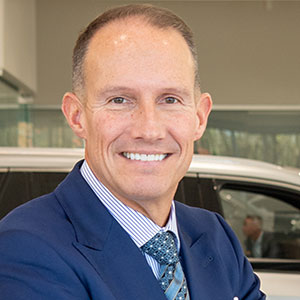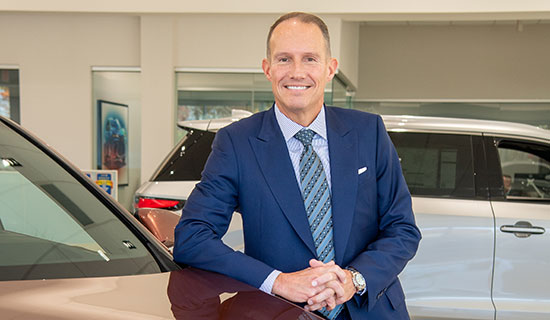
For as long as he can remember, Ken Ganley dreamed of working at the automotive group his father started in 1968.
“Very few little boys and girls dream of being a car dealer, but it’s all I’ve ever wanted to do with my life,” says Ganley, who started working as a porter at age 14, made his first sale at age 16, and began partnering with his father, Tom Ganley, to acquire new dealerships when he was just 21. He once told his dad, “Someday, we’ll have a hundred dealerships.” At the time, Tom just chuckled and said, “It’s always good to dream.” Now, Ganley’s dreams are starting to come true.
Today, the automotive dealer group known as Ken Ganley Companies spans 62 locations in Ohio, Pennsylvania, West Virginia and Florida, employing more than 3,000 team members. The business ended 2024 with $3.1 billion in revenue, and same-store revenue is on track to hit $3.4 billion by the end of 2025 — and thanks to a spree of 11 acquisitions, Ganley expects to close out the year with over $4 billion.
But even as president and CEO, Ganley can’t take sole credit for this growth. He acknowledges the critical role that his team members play in sustaining the auto group’s status as the largest, fastest-growing private auto dealer in Ohio, and one of the largest in the country.
“We’ve been fortunate to have great people, and in any business, that’s the most important thing,” says Ganley, who took over day-to-day operations in 2006 and acquired the rest of the business when his father passed away in 2016. “Every single year, we’ve been able to improve operations, improve revenue and improve profitability, and it has given us the ability to continue to grow.”
Changing with the times
When Tom opened his first dealership in 1968, the business looked much different than it does today. Aside from covering a much smaller geographic footprint back then, “We didn’t have the internet, we didn’t sell cars online, and we didn’t use AI and all these software programs we use today,” Ganley says. “The business is constantly evolving.”
While Tom and his son may have had different leadership styles, they both agreed on one thing: the importance of the people around them.
“He always told me, ‘If you surround yourself with great people, your job’s going to get a lot easier,’ and it’s something I never forgot,” the younger Ganley says. “I used that philosophy when I ran one dealership, and we still try to do that today.”
However, the way that Ganley empowers his team has changed over time. For example, the business uses AI tools today that didn’t exist several years ago, leveraging the technology to streamline basic customer interactions and automate tasks like appointment setting.
“I only want to use technology like AI to make our jobs easier and make it better for the consumer,” Ganley says. “I love the personal aspect of our business, dealing one-on-one with our clients, so I never want to lose that. But you also need to adapt over time and use the tools that are available.”
Expanding into new territory
For the past several years, Ganley’s business has grown steadily, averaging between three to five acquisitions per year. That is, until 2025 when Ganley closed a record-setting 11 deals in one year, adding about $700 million to the bottom line.
“When we went into 2025, we really didn’t have specific acquisition goals or targets,” Ganley says. “These were opportunities that came to us that just made sense, and each one of them made sense in a different way.”
For example, Ganley acquired the Sarchione Group last summer, adding six dealerships to expand its footprint across Northeast Ohio. One of the selling points was that the Sarchione brothers, John and Joe, agreed to stay on board to continue running their dealerships under the same name, while also contributing to some of Ganley’s existing operations.
“They’ve helped improve some of our locations that, quite honestly, needed their help,” Ganley says.
Ganley also acquired Porsche and Audi stores under the Sewickley name in Western Pennsylvania.
“It was a combination of great brands and a great leader running the stores,” Ganley says.
Within a few months, the Sewickley acquisition was already outperforming Ganley’s expectations.
After closing those two deals, Ganley planned to take a break from M&A. But then, Lexus of Cleveland and Akron-Canton dealerships became available, offering “once-in-a-lifetime opportunities” for Ganley to expand into the luxury division of Toyota — a brand he’d been eyeing since opening his first Toyota dealership in 1995.
“It was something that, quite honestly, I couldn’t say no to,” he says. “It’s a dream come true.”
When evaluating acquisitions, Ganley’s team combs through the financial statements, then plugs potential additions into Ganley’s model to identify where they can leverage economies of scale to add efficiencies, lower costs and improve operations.
Years ago, “We used to chase acquisitions that were turnarounds, and we’d put our people in and fix it,” Ganley says. “Quite honestly, that’s what I could afford at the time were turnarounds.”
Although many of those turnarounds have become some of his best performing stores today, Ganley’s acquisition strategy has shifted as his business has grown. Now, he looks for “high-performing locations, high-quality brands and great people,” with the latter being critically important to each deal.
“If I were a seller, I’d be very concerned about my people and wanting to know what’s going to happen with those people,” he says. “We can’t always keep everyone, but we try to keep their core intact. While we may make a leadership change, oftentimes you’ll see 90-plus percent of their team members retained. We’ve been fortunate because our acquisitions have brought us some incredible people, and there’s no price tag on that.”
Developing a winning team
Recognizing that his team holds the keys to his company’s growth, Ganley is committed to equipping employees with the tools they need to succeed. Through the years, he has launched several levels of formal training programs to develop people as they rise up the ranks through internal promotions.
It starts with a two-week training course for new sales hires, led by the company’s corporate trainer. Years ago, Ganley counted on each store manager to train their own employees, before standardizing the curriculum for more consistent onboarding across the company. While these initial classes teach basic sales skills and client relations, Ganley also meets with trainees to share his vision for the company and explain what role new hires can ultimately play in the company’s ongoing growth.
“I always like to end with examples of people who were in their seat in that training class a few years ago and where they are today,” he says. “That gets everyone’s attention.”
Committed to promoting from within, Ganley works with general managers at each store to identify rising stars and top sellers as potential candidates for the Managers in Training (MIT) program. This curriculum prepares employees to advance from sales positions into finance roles, while also teaching soft skills for managing other team members.
“It’s been great for employee morale, because if you see your teammate being put into the MIT program, you’re going to say, ‘Hey, I want to get into that, too,’” Ganley says. “I love seeing that kind of growth. Some of my best general managers today started when they were teenagers washing cars, and we’ve grown them. To me, that’s what it’s all about.”
Building a family legacy
Even Ganley’s own sons follow the same development track as other employees.
“I treat them exactly how my dad treated me,” Ganley says. “I started on the bottom. I washed cars, I swept floors. I had to work my way up through the business. My dad was always very clear with me: ‘If you’re not good, I’m not going to just put you in a management role,’ and I’ve been pretty clear with the boys about it.”
After working summers as young boys, just as Ganley did alongside his father, the third generation is entering the family business. Ganley’s oldest son, Kenny, 24, is now a sales manager at the Toyota store in Akron.
“He has grown to be a fantastic manager,” Ganley says, noting that staff and customers adore him.
Ganley’s middle son, Tyler, is a senior at The Ohio State University who plans to enter the MIT program after he graduates this year. The youngest, Brady, is currently a freshman at Miami University in Ohio. Although he still has several more years of school before he commits to a career, “I think he loves the business as much as his older brothers,” Ganley says. “I always dream about the day when all three of them are working in the business. It would be an absolute dream come true, not only to have them in the business, but to see them do really well.”
Although Ganley, 51, doesn’t plan to retire anytime soon, he’s currently developing the next level of training that will launch in early 2026 to equip future general managers with the skills they need to manage the business assets — including its key asset: people.
Looking ahead
Once again, Ganley heads into the new year with no concrete acquisition targets.
“Growth-wise, every year is kind of an unknown, because you never know who’s going to call and want to sell their car dealership,” he says, noting that most acquisitions result from business owners or their brokers approaching him, instead of the other way around.
“Our plans are certainly to continue our growth, but we don’t have a specific number of dealerships we’ll add in 2026,” he says. “My wife likes to tell me, ‘You’ve got enough on your plate; let’s slow down a little,’ but it’s in my DNA, so I have bad news for her: The next five years will still have dramatic growth.”
On the heels of 11 acquisitions in 2025, Ganley expects to see his dealer group rise in the national rankings. However, his rank doesn’t matter as much as the fact that this growth has happened without any external investment or private equity.
“We’ve grown the business ourselves,” he says, “and I’m proud of that.”
However, Ganley is not trying to grow at all costs or buy up other businesses just to increase numbers.
“Everything we do is pretty strategic, and it has to make sense for our company,” he says. “Sometimes dealers buy just because they feel like they have to, and that’s a mistake. If we don’t buy a dealership in ‘26, but we keep making our stores better, that’s OK, too.”
Whether or not Ganley’s growth this year involves more acquisitions, one thing is certain: He will stay focused on his people, treating them as the most important asset in his business — more precious than all the luxury car brands on the showroom floor.
“People can be your greatest asset, or they can be your biggest liability if you have the wrong ones,” he says. “If you’re constantly surrounding yourself with great people who share your vision and want the best for the rest of the team and the customer, then good things are going to happen.” ●