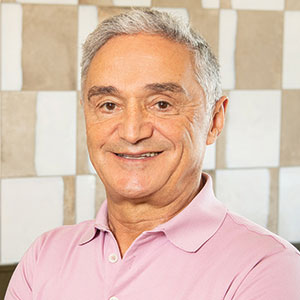
Inspired by the famous tale about Aladdin’s genie who emerged from a magic lamp to grant wishes, Fady Chamoun built Aladdin’s with the same goal: “to make people’s wishes come true.” Whether it’s a server at his Lebanese-American restaurant who aspires to a management position or customers searching for flavorful food at an unbeatable value, their wish is Chamoun’s mission.
Guided by this philosophy and a commitment to friendly service, consistent quality and an elegant-yet-affordable dining experience, Chamoun and his family have grown Aladdin’s to encompass more than 30 locations and several unique restaurant concepts over the past three decades.
Now with some 2,200 employees across a footprint that stretches into four states and abroad under the umbrella of Seasoned Brands LLC, the Chamoun family is focused on extending their heartfelt hospitality as the company continues to grow.
From pizza to pita
Chamoun will never forget the moment he arrived at the airport in 1972, scared to leave his small hometown in Lebanon to attend college in the U.S. But he arrived in America to find a land of opportunity and, eventually, a chance to introduce his Lebanese culture to hungry U.S. consumers.
While earning his degree in mechanical engineering at the University of Michigan, Chamoun began working at Little Caesars Pizza, where he jokes that he “fell in love with the cash register” and decided to build a career in the foodservice industry instead. He quickly worked his way up to management, where he connected with Little Caesars’ founder and owner, Michael Ilitch. A second-generation American, Ilitch took Chamoun under his wing and even co-signed for his first Little Caesars franchise.
“He was a great entrepreneur, and he really cared about us working for him,” Chamoun says. He learned a lot from Ilitch, who in addition to Little Caesars, also owned the Detroit Red Wings, the Detroit Tigers and Fox Theatre in Detroit.
After two decades in the pizza business, where he purchased and ran 40 Little Caesars franchises from Detroit to Cleveland, Chamoun decided to leave the increasingly competitive field to pursue his own restaurant.
“Everybody wanted to do pizza but nobody knew about hummus,” he says, “So, I said, my heritage is Lebanese. There’s got to be a market for that here.”
Chamoun spent a year formulating his plan and searching for the right location before setting his sights on Rankin’s Deli on Detroit Avenue in Lakewood, across the street from the hospital. He walked in one day and told the owner, John Poulos, that he wanted to buy the building. Poulos said, “Get out of here. You don’t have enough money.” But Chamoun persisted, returning several times to make his business case.
Finally, in April 1993, Poulos accepted Chamoun’s offer and sold him the business. Chamoun leveraged his connections at the restaurant equipment company in Detroit that outfitted his Little Caesars franchises, and began setting up his own kitchen. A year later, on April 15, 1994, Chamoun opened the first Aladdin’s with his wife, Sally.
“We had a party and invited all the people I knew to come and eat for free,” says Chamoun, who serves as CEO. “I knew the network was important. My friends are like radios; they talk a lot. Little by little, we built a great reputation.”
Expanding the brand
From the beginning, Chamoun’s vision exceeded the first location in Lakewood, which still operates in the same building that now also houses the company’s corporate offices.
“I learned from Little Caesars if you put a system in place, you can hand the keys over to somebody else and build a chain,” he says. “I was anti-advertising, anti-discounts; just giving the customer a good value, good food and healthy food.”
Within nine months, the first location had generated enough cash flow for Chamoun to put an offer on a second restaurant in Cleveland Heights. Then, in 1996 with three Aladdin’s in operation, Chamoun faced supply chain issues sourcing ingredients for his expanding chain.
“I used to have people drive to Detroit and load up on supplies like chickpeas to bring down here,” he says, “but I had a hard time finding pita bread.”
Seeking a more integrated supply chain, Chamoun approached a local family bakery and offered to buy them out. He established Jasmine Bakery, creating his own “commissary” to provide fresh-baked pita, hand-stuffed grape leaves and other specialty ingredients for his restaurants. With the ability to deliver fresh foods across an eight-hour driving radius, Jasmine fueled Aladdin’s expansion beyond Ohio into neighboring states including Indiana, Pennsylvania and even as far as North Carolina.
Equipped for additional growth, Chamoun continued to extend his Lebanese dining empire beyond the original Aladdin’s concept. He established Taza, A Lebanese Grill, to serve a higher-end market with an average ticket price of $25 to $30; Sittoo’s Lebanese Grill, offering a $5 to $10 price range; and Boaz Fresh Lebanese, a build-your-own bowl or pita roll concept to complement Aladdin’s $15 to $20 ticket range.
“We covered all the different levels in the market to keep the competition out,” Chamoun says.
Today, Jasmine supplies 35 Aladdin’s, three Tazas, seven Sittoo’s and one Boaz location across the Seasoned Brands family of restaurants, in addition to Middle Eastern markets across the region. The distribution center churns out nearly 50,000 bags of fresh pita bred every week just to meet the hummus-dipping demand generated by Chamoun’s customers.
“Everything is made by hands that love to feed and teach people our Lebanese heritage,” explains Chamoun’s daughter, Sandra Daher, vice president of brand strategy. “Health, heritage and human connection really represents our brand, so we try to exemplify that in our restaurants, in our marketing and in everything we do.”
For example, she says, symbols on the menu indicate “Heritage” items from recipes that have been passed down through the generations of Chamoun’s family. Another symbol flags “Heart-Healthy” meal options, while another signals “Human Connection,” designating dishes that are meant to be shared.
“That’s what Lebanese culture is based on,” she says, “that human connection of bringing people together around a table.”
Structured for growth
Although each Seasoned Brands concept revolves around authentic Lebanese-American food, it’s the hospitable service that makes the dining experience memorable at each location.
While several of Aladdin’s operational philosophies focus on the food, others reflect the brand’s commitment to excellent service. The restaurant’s mantra is “Our guests are our friends,” and team members are expected to display honesty, warmth and hospitality, while promoting the brand’s positive reputation in the community.
“The biggest thing is the employees,” Chamoun says. “The biggest challenge is getting bigger, because you could lose that touch.”
To ensure that the personal touch doesn’t fade as the chain expands, teammates undergo ongoing training to reinforce the great service that customers have come to expect.
“We get servers that come in who have never even heard of mujadara,” Chamoun says. “So, we have heavy-duty training. They have to go through classes, take tests and verbally repeat the menu to learn.”
A training center inside the corporate office provides space for employees to come together for centralized classes. Beyond food safety training for kitchen staff and basic training for servers, classes also cover soft skills needed for working in the hospitality industry.
“I was 15 when I started serving here, and that taught me so much about the hospitality business,” Daher says. “It was definitely ingrained in us as kids, but then also taught to us in this work environment.”
In the early days of the business, it was easy for Chamoun to travel to each location to ensure consistent service. Now, vice president of operations Caroline Boyd is charged with developing more sophisticated training systems to embed the same values and standard operating procedures across state lines.
“We’re bringing in people that either have no experience or a lot of experience, so we have a lot of different training systems that we put them through,” Boyd says. “We’ve tried to systemize and structure that more as we’ve grown over the last few years.”
While Chamoun still makes his rounds visiting each location to ensure consistency, that oversight has since trickled down through levels of management.
“We’re so fortunate that we have managers who have been with us for a long time in each restaurant,” Boyd says. “They’ve been able to interact with Fady and his family, so they understand the culture. It’s a restaurant, but it’s a people-first business.”
Preparing for the future
Leadership development has become a big focus as Seasoned Brands has grown, with an eye on preparing the next generation of leaders to carry on the company’s legacy of Lebanese hospitality and healthy food.
“We spend a lot of time and energy on developing management, trying to equip them with skills to develop their people while also teaching them the fundamentals that are important to run a successful restaurant,” Boyd says. “Leadership development is the pipeline of our future; it’s how we have the confidence that we have managers in place who understand the culture and the passion for what we do.”
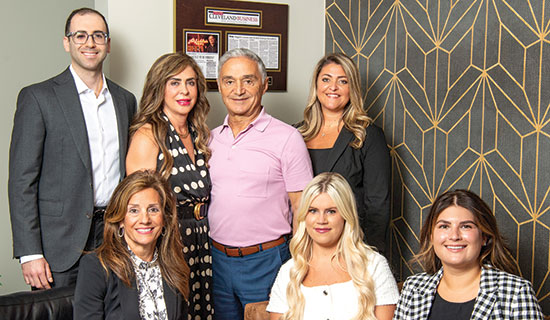
All of Chamoun’s five children, including his sons Fares and Paul Chamoun — owner, partner and CFO; and owner and real estate director, respectively — have worked in the restaurant at some point, if not still actively involved. Now, the third generation is starting to join the company, too. For example, Daher’s oldest son, Ashton, is learning restaurant operations firsthand while studying finance at Miami University. With 13 grandchildren in the family, Chamoun says the business is destined to stay in the family — but he also considers family members beyond his bloodline.
Aladdin’s president Claude Zoghzoghi grew up in Chamoun’s hometown in Lebanon and came to the U.S. to study finance at Cleveland State University before joining the team eight years ago.
“We’re related through the water, not the blood,” jokes Zoghzoghi, whose sister, Zeina, serves as managing partner of Aladdin’s newest location (No. 36), which recently opened in Lebanon.
“I wouldn’t have stayed had I not seen a great opportunity in the company and the team,” Zoghzoghi says. “It’s really fun to grow with a team that’s been with you since the beginning. That’s the best thing you can see, is the people around you growing as the company is growing.”
Looking ahead, Chamoun’s goal is to see the chain continue expanding across the region.
“I’d like to see us at 100 restaurants in a contained, controlled geographic area,” he says, “but I’d rather have quality, not quantity. When you grow, you have to do it carefully to keep your standards.”
With increasingly sophisticated standards and systems in place ensuring that his people are trained and treated like family, Chamoun says the sales and profits will naturally follow.
“Stick with your standards and appreciate your employees,” he says. “Loyalty is a big deal, so if you take care of your people, they will take care of you.” ●